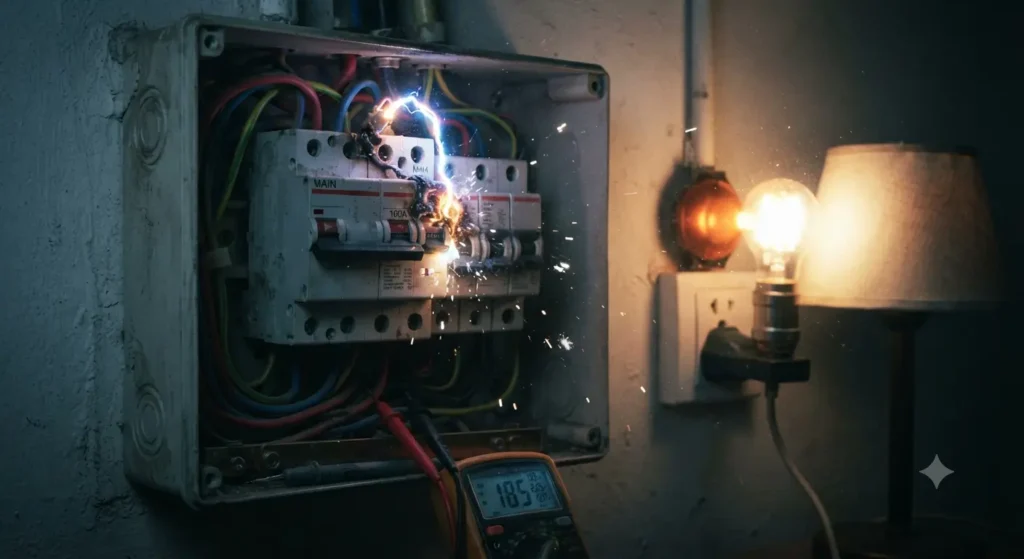
Voltage Fluctuation Is a Warning Sign of an Unstable Electrical System.
Voltage fluctuation is one of the most common electrical problems experienced in homes, commercial buildings, and industrial facilities.
If your lights flicker, fans change speed, or electrical appliances restart unexpectedly, your electrical system may be experiencing unstable voltage.
Voltage fluctuation is a symptom—not the actual fault. The underlying cause may exist within your electrical installation or in the external electricity supply network.
WHAT IS VOLTAGE FLUCTUATION?
Voltage fluctuation is the repeated increase and decrease of supply voltage outside its normal operating range.
Unstable voltage can reduce equipment performance, shorten the lifespan of electrical appliances, interrupt normal operation, and increase the risk of equipment failure.
COMMON SIGNS
You may notice one or more of the following:
- Lights flickering.
- Lights becoming brighter or dimmer unexpectedly.
- Ceiling fans changing speed unexpectedly.
- LED lights flickering or flashing.
- Electrical appliances restarting automatically.
- Computers, Wi-Fi routers, televisions, CCTV systems, network devices, or other electronic equipment restarting intermittently.
- Electrical equipment switching OFF and ON unexpectedly.
- Sensitive electronic equipment malfunctioning.
- Inverters repeatedly switching between mains power and battery mode.
- UPS alarms or abnormal UPS operation.
- Frequent restarting, automatic shutdown, or
- repeated ON/OFF operation of electrical and electronic equipment is often a warning sign of unstable supply voltage and should never be ignored.
POSSIBLE CAUSES
Voltage fluctuation is a symptom—not the actual fault. The source of the problem may be inside your electrical installation or within the external electricity distribution network.
Internal Electrical Causes
- Loose Electrical Connections
- Open Neutral
- Load Imbalance
- Distribution Board Problems
- Power Backup System Failure (Inverter / UPS / Changeover System)
- Improper Cable Sizing
- High Starting Current from Large Electrical Equipment
- External Supply Causes
- Utility Supply Problems
- Transformer Tap Setting Issues
- Distribution Network Problems
- Voltage Rise in Solar-Integrated Electrical Systems
HOW CAN EXTERNAL VOLTAGE PROBLEMS BE MANAGED?
If the voltage problem originates from the external electricity supply network, the most appropriate solution depends on the actual cause. Depending on the site conditions, one or more of the following may be recommended:
- Voltage Stabilizers for individual appliances.
- Servo Voltage Stabilizers for the complete
- electrical installation or critical equipment.
- Surge Protective Devices (SPD) to protect electrical and electronic equipment from transient voltage surges caused by lightning or switching operations.
- Professional electrical assessment to determine whether the problem should be corrected within the property or reported to the electricity supply authority.
- Protective devices can help reduce the impact of voltage-related problems, but they cannot replace proper fault identification and correction.
WHAT SHOULD YOU DO?
If you experience repeated voltage fluctuation:
- Observe when and where the problem occurs.
- Disconnect sensitive electronic equipment if severe voltage changes occur.
- Check whether neighbouring buildings are experiencing the same problem.
- Arrange a professional electrical inspection.
WHAT SHOULD YOU AVOID?
- Do not ignore repeated voltage fluctuation.
- Do not continue operating sensitive electronic equipment during severe voltage instability.
- Do not replace electrical components without identifying the actual cause.
- Do not assume the electricity supplier is always responsible.
WHY IDENTIFYING THE ROOT CAUSE MATTERS
Voltage fluctuation is only a warning sign.
The actual fault may exist inside your electrical installation or within the external electricity distribution network. Installing protective devices or replacing electrical equipment without identifying the root cause may not permanently solve the problem. Identifying the root cause is the first step toward a safe, reliable, and dependable electrical system.
HOW AIGERPEAK CAN HELP
Our team can:
- Measure and analyse voltage stability.
- Inspect the complete electrical installation.
- Check for loose electrical connections and open neutral conditions.
- Evaluate load balancing.
- Inspect the distribution board.
- Assess inverter, UPS, and power backup systems.
- Identify voltage rise in solar-integrated systems.
- Recommend voltage protection where appropriate.
- Recommend permanent corrective actions.
- Depending on the inspection results, we may recommend:
- PEIC (Professional Electrical Inspection &
- Consulting)
- Emergency Electrician
- Home AMC
FREQUENTLY ASKED QUESTIONS
Yes. Continuous voltage fluctuation can reduce the lifespan of electrical appliances and permanently damage sensitive electronic equipment.
No. The cause may originate inside your electrical installation, within the external electricity distribution network, or both.
Yes. Under certain operating conditions, rooftop solar systems may experience voltage rise.
Professional assessment is required to determine the exact cause.
A voltage stabilizer or servo voltage stabilizer can help protect electrical equipment from unstable voltage in many situations. However, the underlying cause should still be identified and corrected.
If voltage fluctuations occur repeatedly, appliances restart unexpectedly, lights flicker frequently, or electronic equipment behaves abnormally, your electrical system should be professionally inspected.